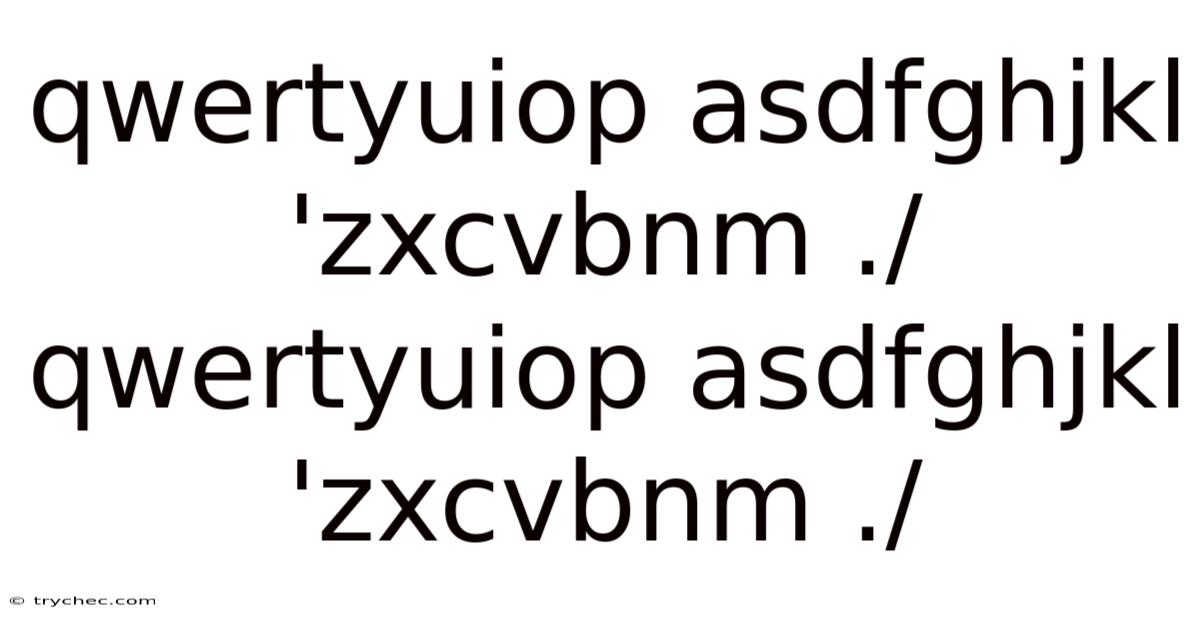
The seemingly random sequence "qwertyuiop asdfghjkl 'zxcvbnm .In practice, / qwertyuiop asdfghjkl 'zxcvbnm . /" holds more significance than initially meets the eye, acting as a key to understanding the history of typing, keyboard layouts, and even the evolution of human-computer interaction. This seemingly nonsensical string of characters encapsulates a fascinating story of technological innovation, ergonomic considerations, and the enduring legacy of a design choice that continues to shape how we communicate and interact with the digital world Which is the point..
And yeah — that's actually more nuanced than it sounds.
The Genesis of QWERTY: More Than Just Random Keys
The QWERTY layout, the foundation of the character string in question, wasn't born out of a desire for efficiency or ergonomic comfort. Even so, its origin lies in the mechanics of early typewriters. Christopher Latham Sholes, the inventor credited with the QWERTY layout, faced a significant challenge: preventing type bars from jamming And that's really what it comes down to..
Early typewriters used a mechanical system where type bars, each bearing a specific character, would strike the paper. When frequently used letters were positioned next to each other, their corresponding type bars would often collide and jam, disrupting the typing process and frustrating users.
Sholes's solution was ingenious, albeit counterintuitive from a modern ergonomic perspective. In practice, he strategically separated commonly used letter pairs to minimize the likelihood of type bar collisions. This deliberate arrangement, prioritizing mechanical functionality over typing speed, resulted in the QWERTY layout we know today.
The prevalence of the QWERTY layout wasn't solely due to its mechanical ingenuity. On top of that, this widespread adoption created a network effect, making it increasingly difficult for alternative layouts to gain traction. Practically speaking, as typewriters gained popularity, typing schools emerged, teaching students the QWERTY method. Businesses invested in QWERTY typewriters and trained their staff accordingly, further solidifying its dominance It's one of those things that adds up. That alone is useful..
Decoding "asdfghjkl": The Home Row Advantage
The string "asdfghjkl" is significant because it represents the home row on the QWERTY keyboard. The home row is the central row where the typist's fingers rest, allowing for efficient and comfortable typing. Touch typing, a skill taught in typing schools, emphasizes keeping the fingers on the home row and reaching for other keys with minimal hand movement Nothing fancy..
The home row is strategically designed to provide easy access to frequently used letters. While the QWERTY layout wasn't optimized for speed, the home row placement does offer a degree of efficiency. Touch typing, by leveraging the home row, enables experienced typists to achieve remarkable speeds and accuracy.
The importance of the home row extends beyond the QWERTY layout. Many alternative keyboard layouts, such as Dvorak, also incorporate the concept of a home row, albeit with a different arrangement of letters. The underlying principle remains the same: to minimize hand movement and maximize typing efficiency It's one of those things that adds up..
Unraveling "zxcvbnm ./": The Bottom Row and Special Characters
The final segment, "zxcvbnm .That's why this row contains less frequently used letters and essential symbols like the period (. Day to day, /", represents the bottom row of the QWERTY keyboard, along with some punctuation marks. ) and forward slash (/) Most people skip this — try not to..
The placement of these characters on the bottom row reflects their lower frequency of use in the English language. While "z," "x," "c," "v," "b," "n," and "m" are necessary for spelling, they appear less often than letters on the home row or top row.
The official docs gloss over this. That's a mistake.
The inclusion of the period and forward slash on the bottom row highlights the importance of punctuation in written communication. These symbols, along with others like commas, question marks, and exclamation points, add clarity and nuance to text.
QWERTY's Challengers: Alternative Keyboard Layouts
Despite its widespread adoption, the QWERTY layout has faced numerous challenges from alternative designs that claim to offer superior efficiency and ergonomics. The most well-known alternative is the Dvorak Simplified Keyboard And it works..
The Dvorak Simplified Keyboard
Designed by August Dvorak in the 1930s, the Dvorak layout aims to optimize typing speed and reduce fatigue by placing the most frequently used letters on the home row and alternating between hands. Studies conducted by Dvorak and his proponents suggested significant improvements in typing speed and accuracy compared to QWERTY.
The Dvorak layout boasts several key advantages:
- Reduced finger travel: By placing frequently used letters on the home row, Dvorak minimizes the distance fingers need to travel, leading to less fatigue and faster typing speeds.
- Alternating hand usage: Dvorak promotes alternating hand usage, distributing the workload more evenly and reducing strain on one hand.
- Reduced error rates: Proponents claim that Dvorak's optimized layout leads to fewer typing errors.
Despite these potential benefits, the Dvorak layout has struggled to gain widespread adoption. On the flip side, the primary obstacle is the established dominance of QWERTY. Switching to Dvorak requires retraining, which can be time-consuming and disruptive for experienced QWERTY typists. The network effect, which initially propelled QWERTY to prominence, now hinders the adoption of alternatives Not complicated — just consistent..
Other Alternative Layouts
Besides Dvorak, other alternative keyboard layouts have emerged, each with its own unique design principles and claimed advantages. These include:
- Colemak: A modern alternative that aims to balance ease of learning with improved efficiency.
- Workman: Another modern layout designed for ergonomic comfort and efficient typing.
- MTGAP: A layout designed to be easily adaptable from QWERTY while offering improvements in speed and comfort.
While these layouts may offer advantages over QWERTY in terms of speed or ergonomics, they face the same uphill battle in gaining widespread adoption. The deeply entrenched dominance of QWERTY remains a significant barrier.
The Enduring Legacy of QWERTY in the Digital Age
Despite the emergence of alternative layouts and the shift from mechanical typewriters to digital devices, the QWERTY layout persists as the dominant keyboard arrangement. Its enduring legacy can be attributed to several factors:
- Familiarity: Generations of users have learned to type on QWERTY keyboards, making it the default and most familiar layout.
- Software and hardware support: Operating systems and hardware manufacturers universally support QWERTY, ensuring compatibility across different devices and platforms.
- Network effect: The widespread adoption of QWERTY creates a network effect, making it difficult for alternatives to gain traction.
- Adaptability: While not originally designed for digital devices, QWERTY has proven adaptable to computer keyboards, smartphones, and tablets.
The QWERTY layout has even transcended physical keyboards. Virtual keyboards on touch screen devices typically use the QWERTY arrangement, allowing users to make use of their existing typing skills.
The Science Behind Keyboard Layouts: Ergonomics and Efficiency
The design of keyboard layouts is a complex field that involves considerations of ergonomics, efficiency, and cognitive factors. Ergonomics focuses on designing products and systems that optimize human well-being and overall system performance. In the context of keyboard layouts, ergonomics aims to minimize strain, reduce fatigue, and prevent repetitive stress injuries Most people skip this — try not to..
Efficiency, on the other hand, focuses on maximizing typing speed and accuracy. An efficient keyboard layout should allow users to type quickly and accurately with minimal effort.
Cognitive factors also play a role in keyboard layout design. The layout should be easy to learn and remember, and it should minimize cognitive load.
Researchers have used various methods to evaluate keyboard layouts, including:
- Typing speed tests: Measuring the number of words per minute (WPM) that users can type on different layouts.
- Error rate analysis: Analyzing the frequency and types of errors made on different layouts.
- Muscle activity measurements: Using electromyography (EMG) to measure muscle activity in the hands and arms while typing on different layouts.
- Subjective feedback: Gathering user feedback on comfort, ease of use, and overall satisfaction with different layouts.
These studies have provided valuable insights into the strengths and weaknesses of different keyboard layouts, but they have not led to a definitive conclusion about which layout is "best." The optimal layout may depend on individual factors, such as typing style, hand size, and personal preferences Simple, but easy to overlook. But it adds up..
People argue about this. Here's where I land on it.
QWERTY on Mobile Devices: Adaptation and Alternatives
The prevalence of smartphones and tablets has introduced new challenges and opportunities for keyboard layout design. While virtual keyboards on these devices typically use the QWERTY arrangement, the limited screen space and the use of thumbs for typing have led to the development of alternative layouts optimized for mobile devices Small thing, real impact..
One popular alternative is the T9 predictive text input method, which was widely used on early mobile phones. T9 uses a reduced keypad with multiple letters assigned to each key. The software predicts the intended word based on the sequence of key presses and a built-in dictionary.
Another approach is to use gesture-based typing, where users swipe their finger across the keyboard to form words. SwiftKey and Google Keyboard are popular examples of virtual keyboards that support gesture typing.
Adding to this, some mobile keyboards offer customizable layouts, allowing users to rearrange the keys to suit their individual preferences. This flexibility can be particularly useful for users who are accustomed to alternative layouts or who have specific accessibility needs Most people skip this — try not to..
The Future of Keyboard Layouts: AI and Customization
The future of keyboard layouts is likely to be shaped by advancements in artificial intelligence (AI) and increasing demand for customization. AI-powered keyboards can learn from user behavior and adapt the layout dynamically to optimize typing speed and accuracy.
As an example, an AI keyboard could analyze the user's typing patterns and adjust the size and position of keys based on their individual finger movements. It could also predict the next word the user is likely to type and make it easier to access No workaround needed..
Customization is another key trend in keyboard layout design. Users are increasingly demanding the ability to personalize their keyboards to suit their individual needs and preferences. This includes the ability to:
- Remap keys: Assign different functions to specific keys.
- Create custom layouts: Design entirely new layouts from scratch.
- Adjust key sizes and spacing: Optimize the keyboard for different hand sizes and typing styles.
- Change the appearance: Customize the colors, fonts, and other visual elements of the keyboard.
These trends suggest that the future of keyboard layouts will be more personalized and adaptive, allowing users to tailor their typing experience to their specific needs and preferences. The seemingly random sequence "qwertyuiop asdfghjkl 'zxcvbnm .Practically speaking, / qwertyuiop asdfghjkl 'zxcvbnm . /" will likely remain a recognizable reference point, even as keyboard technology continues to evolve And that's really what it comes down to..
Conclusion: The Enduring Impact of a Mechanical Solution
The string "qwertyuiop asdfghjkl 'zxcvbnm ./ qwertyuiop asdfghjkl 'zxcvbnm ./" serves as a powerful reminder that even seemingly arbitrary design choices can have a profound and lasting impact. The QWERTY layout, born out of the mechanical constraints of early typewriters, has shaped the way we interact with technology for over a century. While alternative layouts may offer potential advantages in terms of efficiency and ergonomics, the QWERTY layout's dominance remains unchallenged due to familiarity, software and hardware support, and the network effect. Day to day, as technology continues to evolve, the future of keyboard layouts is likely to be shaped by AI and customization, but the legacy of QWERTY will undoubtedly endure. It stands as a testament to the power of technological path dependency and the enduring influence of design decisions made long ago That's the part that actually makes a difference..
